
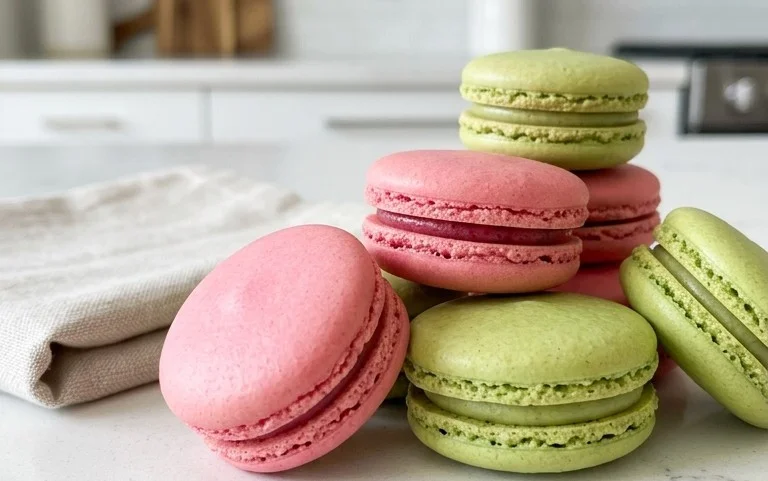
French macarons are more than just a cookie; they are miniature works of art, delicate clouds of sweetness that melt in your mouth. For many, the very mention of a French macaron conjures images of Parisian patisseries, vibrant colors, and an almost ethereal texture. But what is it about these small, sandwiched confections that captivates our taste buds and our imagin extractations? It’s the perfect marriage of a crisp, slightly chewy shell giving way to a luscious, creamy filling. The satisfying “feet” that rise proudly during baking are a testament to the baker’s skill, and the endless flavor possibilities, from classic vanilla bean to exotic salted caramel, make each French macaron a delightful discovery. Today, I’m thrilled to share my secrets to achieving these delightful French macarons in your own kitchen, so you can experience their magic firsthand.

French Macaron Recipe
Ah, the French macaron. These delicate, ethereal cookies are a true test of patience and precision, but oh-so-worth the effort. With their crisp outer shell that gives way to a chewy, melt-in-your-mouth interior, and their endless possibilities for vibrant colors and decadent fillings, macarons are a showstopper dessert. Mastering them might seem daunting, but with this detailed guide, you’ll be well on your way to creating your own beautiful and delicious macarons. Don’t be discouraged if your first batch isn’t perfect; it’s a learning curve, and each attempt brings you closer to macaron perfection!
Ingredients:
Preparing Your Ingredients and Tools
Before we even begin extract mixing, it’s crucial to have everything prepped and ready. This recipe relies on precise measurements and careful handling, so let’s set ourselves up for success. First, ensure your egg whites are at room temperature. This is vital for achieving the proper meringue structure. You can achieve this by separating your eggs a day in advance and leaving them covered at room temperature, or by placing your separated egg whites in a clean bowl set over a pot of barely simmering water (a double boiler, essentially) for a few minutes until they reach body temperature. Do not let them cook; you just want them warmed.
Next, the almond flour and powdered sugar. It’s imperative to sift these together at least twice, preferably three times. Use a very fine mesh sieve. This step removes any lumps and ensures an ultra-smooth batter, which is key to those coveted “feet” (the ruffled edge at the bottom of the macaron) and a smooth shell. If you don’t have super-fine almond flour, you can pulse regular almond flour briefly in a food processor, but be careful not to over-process it into almond butter. Sifting is non-negotiable for that silky texture. The salt is also added here to help balance the sweetness and enhance the flavors.
Making the Meringue
This is perhaps the most critical phase. We’ll be making a French meringue, which involves whipping egg whites with granulated sugar.
1. In a meticulously clean, grease-free bowl of your stand mixer (or using a hand mixer), add the room temperature egg whites and a pinch of the salt. Start whipping on medium-low speed until the egg whites become foamy and opaque. Gradually increase the speed to medium-high.
2. Once the egg whites reach a soft peak stage (when you lift the whisk, a soft peak forms and then droops over), begin extract to slowly add the granulated sugar, a tablespoon at a time, while the mixer is still running. Continue mixing until all the sugar is incorporated and the meringue is glossy, stiff, and holds a firm peak. You should be able to turn the bowl upside down without the meringue sliding out. This is your foundation for a stable macaron.
Adding Color and Flavor
Now it’s time to bring in some personality!
3. Once your meringue has reached stiff peaks, add the liquid-gel food coloring and the vanilla extract. If you’re using liquid food coloring, be aware that it can add a bit too much moisture, so gel or powder is preferred for macarons. Mix on low speed until the color is evenly distributed and the desired hue is achieved. Be cautious not to overmix at this stage, as you don’t want to deflate the meringue.
Macaronage: The Art of Folding
This is where the magic truly happens, and it’s the most commonly fumbled step for begin extractners. Macaronage is the process of folding the dry ingredients into the meringue.
4. Sift the almond flour and powdered sugar mixture (which you’ve already prepared) into the bowl with the meringue. Now, using a rubber spatula, begin extract to gently fold the dry ingredients into the meringue. Start by cutting through the center of the mixture, then scraping around the edge of the bowl. Rotate the bowl as you fold. The key here is to deflate the meringue just enough so that when you lift the spatula, the batter flows off in a thick, continuous ribbon. It should fall like molten lava, and when you draw a figure-eight with the batter, the lines should slowly melt back into the rest of the batter within about 20-30 seconds. If it’s too stiff, it will hold its shape and create bumpy macarons. If it’s too thin and runny, your macarons will spread too much and won’t develop their signature shape. Don’t overmix; it’s better to err on the side of slightly under-mixed than over-mixed.
Piping and Resting
Getting the batter onto the baking sheets is the next step.
5. Transfer the macaron batter into a piping bag fitted with a round tip (about 1/2 inch). Line two baking sheets with parchment paper or silicone baking mats. Hold the piping bag directly over the baking sheet and pipe small, uniform rounds, about 1 to 1.5 inches in diameter, leaving about an inch of space between each one. To get perfectly round macarons, hold the bag perpendicular to the sheet and stop squeezing before lifting. Once piped, firmly tap the baking sheets on the counter several times. This releases any trapped air bubbles that could cause the macarons to crack.
6. Allow the piped macarons to rest at room temperature for at least 30 minutes, or up to an hour. You’ll know they’re ready to bake when they have formed a dry skin on the surface. When you gently touch one, it shouldn’t stick to your finger. This skin is crucial for developing those beautiful feet during baking. The drying time will vary depending on the humidity in your kitchen.
Baking Your Macarons
The final stage of creation!
7. Preheat your oven to 300°F (150°C). Bake one sheet at a time, placing it on the center rack. Bake for 12-15 minutes, or until the macarons have developed their feet and the tops are firm to the touch. They should lift easily off the parchment paper. If they are sticking, they need a few more minutes. Ovens vary, so keep an eye on them. Once baked, remove the sheets from the oven and let the macarons cool completely on the baking sheets before attempting to remove them. Trying to move them while warm will likely result in broken shells.
Assembly
Once your macaron shells are completely cool, it’s time to bring them to life! Pair up similar-sized shells. Pipe a generous dollop of your chosen filling (vanilla buttercream is a classic) onto the flat side of one shell, then gently sandwich it with another shell.
Maturation
The final, patient step.
8. Once assembled, place the macarons in an airtight container and refrigerate them for at least 24 hours. This “maturation” period allows the shells to absorb moisture from the filling, softening them to that perfect chewy texture and melding the flavors beautifully. Don’t skip this! Your patience will be rewarded.
Enjoy your homemade French macarons! They are a labor of love, but the result is undeniably spectacular.

Conclusion:
Embarking on the journey of making French macarons can seem daunting, but as you’ve seen, with patience and precision, these delicate, airy cookies are absolutely achievable! This recipe is a fantastic starting point, offering you the chance to create those iconic, melt-in-your-mouth shells with their signature “foot.” The beauty of French macarons lies not only in their elegant appearance but also in their incredible versatility. Imagin extracte pairing these sweet delights with a rich ganache, a tangy fruit curd, or a classic buttercream. They are perfect for special occasions, afternoon tea, or simply as a delightful treat to brighten your day. Don’t be discouraged if your first batch isn’t absolutely perfect; practice truly makes perfect with macarons! Experiment with different flavorings and colorings to create your own unique creations. I wholeheartedly encourage you to give this French Macaron Recipe a try – the reward of biting into your own homemade macaron is truly unparalleled!
Frequently Asked Questions:
Why are my macaron shells cracking on top?
Cracking often happens when the oven temperature is too high, the meringue is over-whipped, or the batter is not properly rested after piping. Ensure your oven temperature is accurate and allow the piped macarons to sit at room temperature for 30-60 minutes until a dry skin forms before baking. This resting period is crucial for developing that characteristic “foot” and preventing cracks.
My macarons are hollow inside. What did I do wrong?
Hollow macarons are a common frustration! This can be caused by several factors, including an under-whipped meringue, an oven that’s too hot (causing the shells to cook too quickly and not fill out), or over-mixing the batter, which deflates the meringue. Ensure your meringue is stiff and glossy, and try reducing your oven temperature slightly. Gentle folding of the dry ingredients into the meringue is key to maintaining airiness.
Can I make macaron shells ahead of time?
Yes, absolutely! Once baked and completely cooled, macaron shells can be stored in an airtight container at room temperature for a day or two, or in the refrigerator for up to a week. For longer storage, they freeze beautifully! Simply place them in an airtight container with parchment paper between layers and freeze for up to three months. Thaw them at room temperature before filling.
French Macaron Recipe
A classic recipe for making delicate and delicious French macarons with a smooth, chewy texture and a crisp shell.
Ingredients
-
150 grams sifted super-fine almond flour
-
180 grams powdered sugar
-
1/4 teaspoon salt
-
120 grams large egg whites (at room temperature)
-
60 grams granulated sugar
-
4 drops liquid-gel food coloring
-
1 teaspoon pure vanilla extract
Instructions
-
Step 1
Combine the sifted almond flour, powdered sugar, and salt in a food processor. Pulse a few times to ensure a fine, uniform mixture. Sift this mixture into a large bowl, discarding any large almond pieces. -
Step 2
In a separate clean bowl, whisk the egg whites until frothy. Gradually add the granulated sugar, a tablespoon at a time, while continuing to whisk. Add the food coloring and vanilla extract. Continue whisking until stiff, glossy peaks form, and the meringue is firm when the whisk is lifted. -
Step 3
Gently fold about one-third of the meringue into the almond flour mixture to lighten it. Then, carefully fold in the remaining meringue until the batter is smooth and flows like lava. Be careful not to overmix. -
Step 4
Transfer the batter to a piping bag fitted with a round tip. Pipe small circles (about 1-inch diameter) onto baking sheets lined with parchment paper or silicone mats. Leave about 1 inch between each macaron. -
Step 5
Tap the baking sheets firmly on the counter several times to release any air bubbles. Let the piped macarons sit at room temperature for at least 30 minutes to form a skin. -
Step 6
Preheat oven to 300°F (150°C). Bake for 18-20 minutes, or until the macarons have developed ‘feet’ and are firm to the touch. Let them cool completely on the baking sheets before attempting to remove them. -
Step 7
Once cooled, pair matching macaron shells and fill with your choice of frosting or filling. Let the filled macarons mature in the refrigerator for at least 24 hours before serving for the best texture.
Important Information
Nutrition Facts (Per Serving)
It is important to consider this information as approximate and not to use it as definitive health advice.
Allergy Information
Please check ingredients for potential allergens and consult a health professional if in doubt.
Leave a Comment